


I woke up this morning, with intense sunlight declaring war on my eyelids. I opened my eyes, and it went from black to scathing white in seconds, with all the light zooming into my eye at once. Then my vision settled into reality, just to see my cat staring at me, inches from my face.
In that moment, I started thinking about light, the electromagnetic waves that are radiated from the sun, transmitted through the clouds, refracted through the window, reflected off the walls, and made their way into my eye like an uninvited guest, flooding my retina and creating one vivid moment of awareness. Slowly, as my pupils shrank to minimize the blinding light, a small portion of light waves made their way into my retina, creating an inverted image of my surroundings. My walnut-shaped brain then inverted the image to one I could make sense of.
When light hits a surface, the object reflects some light, absorbs some light, and transmits some light. Those are really the only three things it can do. When we ‘see’ an object, we’re actually seeing the light reflected from it. In other words, we’re seeing the light it rejected, not its actual, intrinsic color. Kind of like people, really. What you see is what they choose to show you, not what’s hidden inside.
Light has different personalities. While reflection, refraction, polarization, diffraction, and interference can be beautifully described by wave theory, we had to revert to particle theory to explain phenomena like the photoelectric effect, blackbody radiation, atomic emission spectra, and the Compton effect. Again, light is a lot like people that way, wearing one mask in public, one mask with family, and one in the shadows.
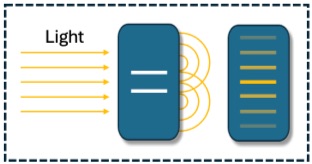
Like when you forget all the answers in an interview or a presentation, but can write pages and pages confidently when no one is looking, light is also very self-conscious. The moment we try to observe it, light changes its behavior. One minute it’s acting as a wave, and just as we try to measure it, it starts acting like a good little particle. This is best seen in Young’s double slit experiment, where light is sent through 2 slits. When light is not observed, it behaves like ripples of water, flowing through both slits and forming an elegant interference pattern like the figure on the left.
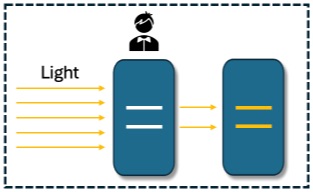
But when it is observed, when we intentionally measure which slit light goes through, it acts like a particle and produces two distinct output spots like the figure on the left.
Like this identity crisis wasn’t enough, light is also very secretive. It does not let you know everything about it. You can know its exact energy or time, but not both. Its exact position or momentum, but not both. This is what ruptured the classical physics worldview and gave birth to a more probabilistic approach called quantum mechanics.

Let’s say you have a narrow staircase, and you want to know the location of each step where most people place their feet. You could stand on the steps and observe where each person steps, but because of your presence on the steps, people will move to the side away from you, and you will be contaminating the measurement.
On the other hand, you can step aside, let people climb up or down, and then check the wear and tear of the steps. The dents on the steps will let you know where most people stepped. This is called probability, and this is how quantum mechanics operates. In this example, the place with the most depression is the most probable location for a step, just like the worn areas shown in the image on the left.
That’s light for you, mysterious, dual personality, classical rule breaker, and a trendsetter that casually enforces the universe’s speed limit, like it owns the place. And honestly? We’re all just trying to catch up.